
The Ritual of Self-Massage

abhyanga
◦ nourish the body ◦ calm the mind ◦ ground the nervous system
My relationship with body oiling began long before I thought of it as a ritual.
Before my accident, I was the bendy yoga girl, a marathon runner—the kind of person who thought going for a ten-mile run in the Headlands sounded like fun. Then a pretty gnarly accident stopped me completely in my tracks.
I was left dealing with chronic pain, inflammation, limited mobility, and eventually a total hip replacement. The body I had known for most of my life suddenly felt very different.
The accident didn't just slow me down physically. It completely changed the trajectory of my life.
I didn’t realize that, in some way, the universe had probably been quietly telling me to slow down for years.
You know that saying... the body whispers before it screams?
Well, my nervous system was screaming.
And I had no choice but to listen.
The nervous system impacts every breath, feeling, decision, and experience in our lives. Most of us tend to focus our attention on imbalances in the physical body, yet Ayurveda also asks us to look at the mind and nervous system.
For me, that meant first becoming aware of how much stress I was carrying, and then finding practices that created a little more spaciousness and ease.
Daily acts of self-care—like abhyanga—gave me a way to slow down, pay attention, and offer my body and nervous system the nourishment they needed.
Somewhere during that period, I found one of the simplest practices that would stay with me for years: warm baths followed by self-massage.
Every night after work, I would go to yoga—even if some days that meant mostly lying in savasana—then come home, take a warm herbal salt bath, and massage oil into my body.
There wasn't an elaborate ritual around it in the beginning.
I just kept doing it.
Night after night.
And I began to notice things.
The pain would ease. My joints felt less stiff and somehow more nourished. My circulation felt better. My skin began to glow.
But the biggest shift wasn't necessarily the one I could see.
My nervous system felt calmer.
After spending so much time in pain and feeling disconnected from the body I once knew, the simple act of caring for myself created a gentle shift.
Little by little, I felt like I was recovering—not only physically, but in the way I inhabited my own body. For those few minutes every night, I wasn't fighting with it or wishing it were different.
I was caring for it.
There was something incredibly restorative about the combination of warmth, oil, touch, and time.
discovering abhyanga
As I began studying Ayurveda more deeply, I learned that what I had instinctively been doing had a name.
Abhyanga is the Ayurvedic practice of oil massage, traditionally performed with warm oil before bathing. It is commonly practiced as part of dinacharya—the daily rituals used to support balance over time.
Later, during a Panchakarma retreat, I experienced another side of the practice. I was oiled daily, and it completely shifted the way I understood body oiling.
Ayurveda looks closely at qualities: dry and oily, cold and warm, heavy and light, mobile and still.
As we age, Vata qualities such as dryness and stiffness naturally become more pronounced. Looking at what I had been experiencing through that lens made so much sense to me.
The answer felt remarkably simple:
put nourishment back into the body.
Oil the skin.
Massage the joints.
Slow down.
Create warmth.
Love yourself.
That last part became increasingly important to me.
One of the Sanskrit words I came across in my studies was sneha. In Ayurveda, it can refer to oil or oleation, but it also carries the meaning of affection or love.
I remember thinking: of course it does.
Because by then, that was what the practice had become for me.
For years, I had wanted my old body back. I wanted it to move differently. I wanted the pain to stop. I wanted to be the person I had been before the accident.
But underneath all of that was something much simpler that I needed to hear:
love the body you're in now.
Not when it heals.
Not when it gets stronger.
Not when it moves the way it once did.
Now.
That is where self-massage became something much deeper than body care.
oil as ritual
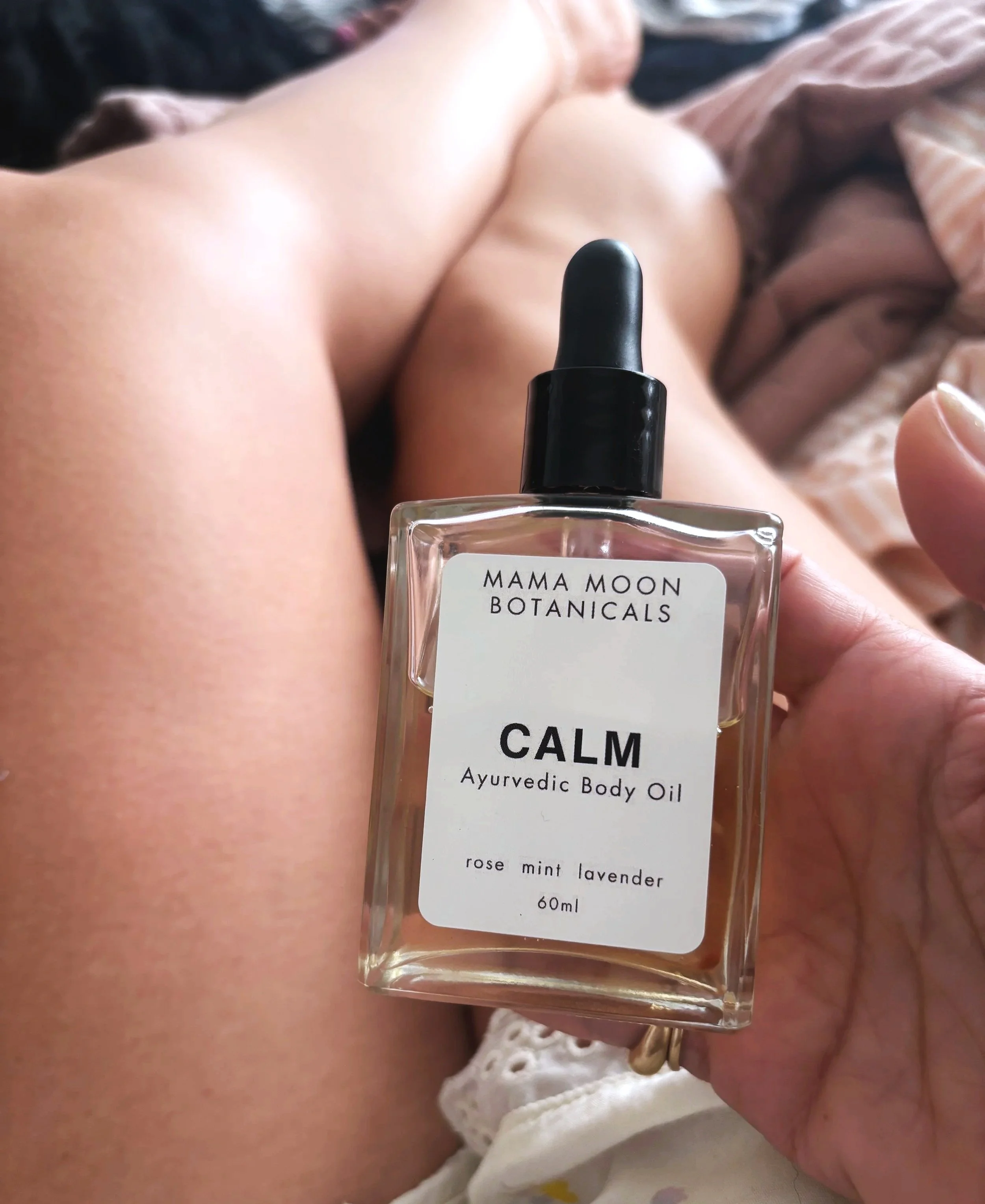
It's always interesting bringing the body oils to markets because a surprising number of people aren't quite sure what to do with them.
“Do I use this instead of lotion?”
Yes—but to me, body oil is something very different from lotion.
I don't think about it simply as moisturizing the skin. Oiling the body creates an opportunity to actually slow down and care for yourself.
When you slow down enough to massage your own body, you begin noticing things.
Where am I holding tension?
Where am I dry?
Where does something feel tight?
Is there a knot that needs a little love?
What actually feels good today?
We so often hand our bodies over to other people—to doctors, massage therapists, practitioners, and healers. There is tremendous value in receiving care, but there is also something powerful about becoming an active participant in your own care.
By slowing down and turning inward, we become more familiar with ourselves.
We start learning the language of our own bodies.
We become are own healers.
And for me, that is part of what self-love actually looks like.
the body remembers
Over time, I also became increasingly interested in the relationship between our emotional lives, the nervous system, and the physical body.
Our experiences don't happen exclusively in our minds.
Stress, grief, fear, trauma, and physical injury can all influence the way we move through and experience our bodies.
I don't believe every ache or stiff joint has some hidden emotional explanation. Sometimes pain is pain, and mine certainly had a very real physical cause.
But I do believe the body communicates.
Sometimes tension, exhaustion, stiffness, or that feeling of being completely disconnected from yourself may be telling you something.
Slow down. Rest. Move. Feel.
Maybe something needs attention.
Maybe something needs to be released.
Maybe you simply need to stop pushing for a minute and listen.
Self-massage gave me a quiet way to begin doing that.
choose your ritual
In Ayurveda, oils may be selected according to your constitution, the season, and what is happening in the body and mind at that particular moment.
Sesame is one of the most widely used oils for Ayurvedic massage. It is rich, warming, and nourishing, making it especially beautiful when Vata qualities such as dryness, coldness, restlessness, or depletion are present.
Coconut is naturally more cooling and can feel especially supportive during warmer months or when the heat and intensity associated with Pitta are elevated.
This idea of working with qualities and their opposites became part of how I formulated the three MAMA MOON BOTANICALS Ayurvedic body oils.
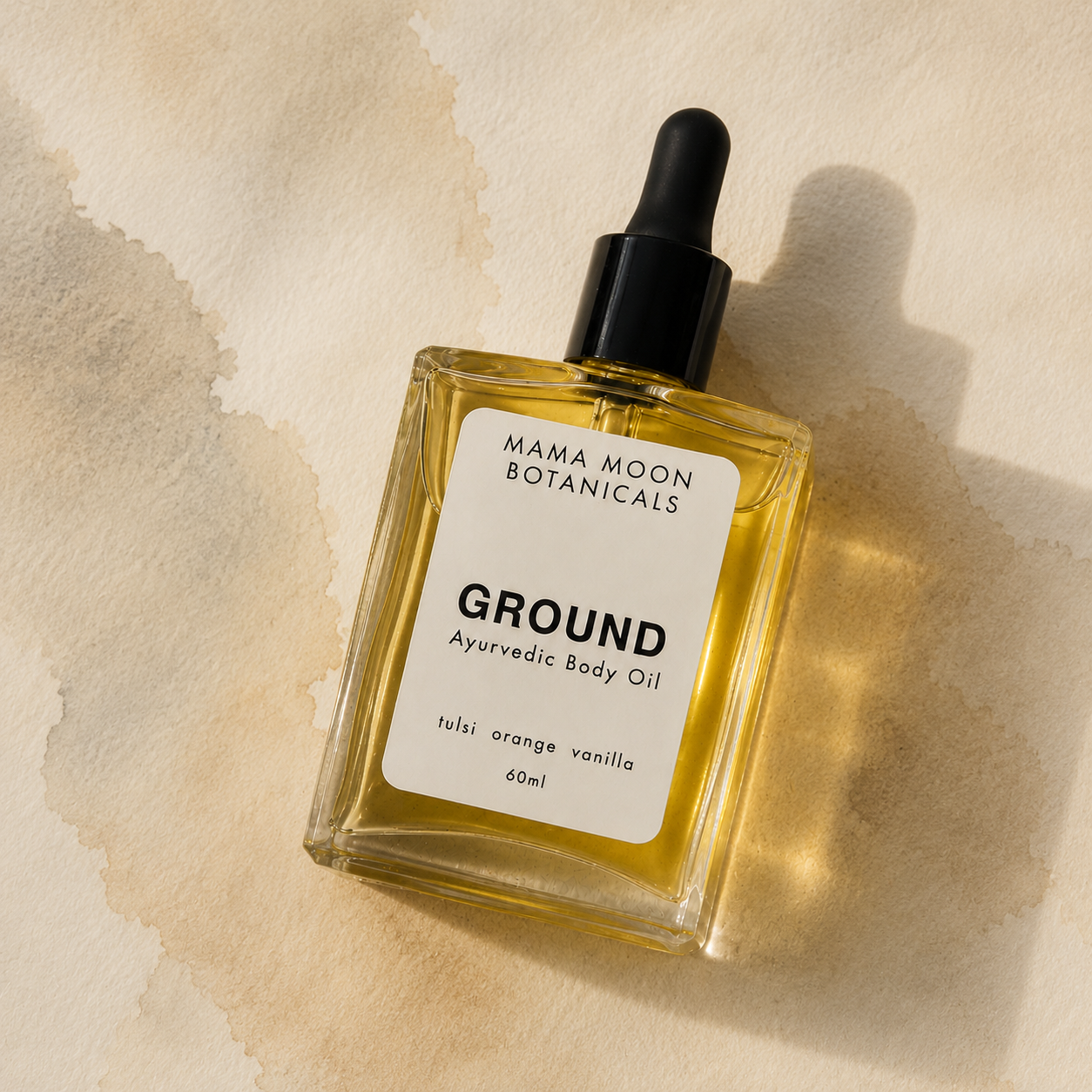
GROUND
nourishing • grounding • warming
Created primarily with Vata in mind—the monkey mind, overstimulation, dryness, stiffness, and that feeling of being everywhere except inside your own body. I especially love GROUND during fall and cooler weather.
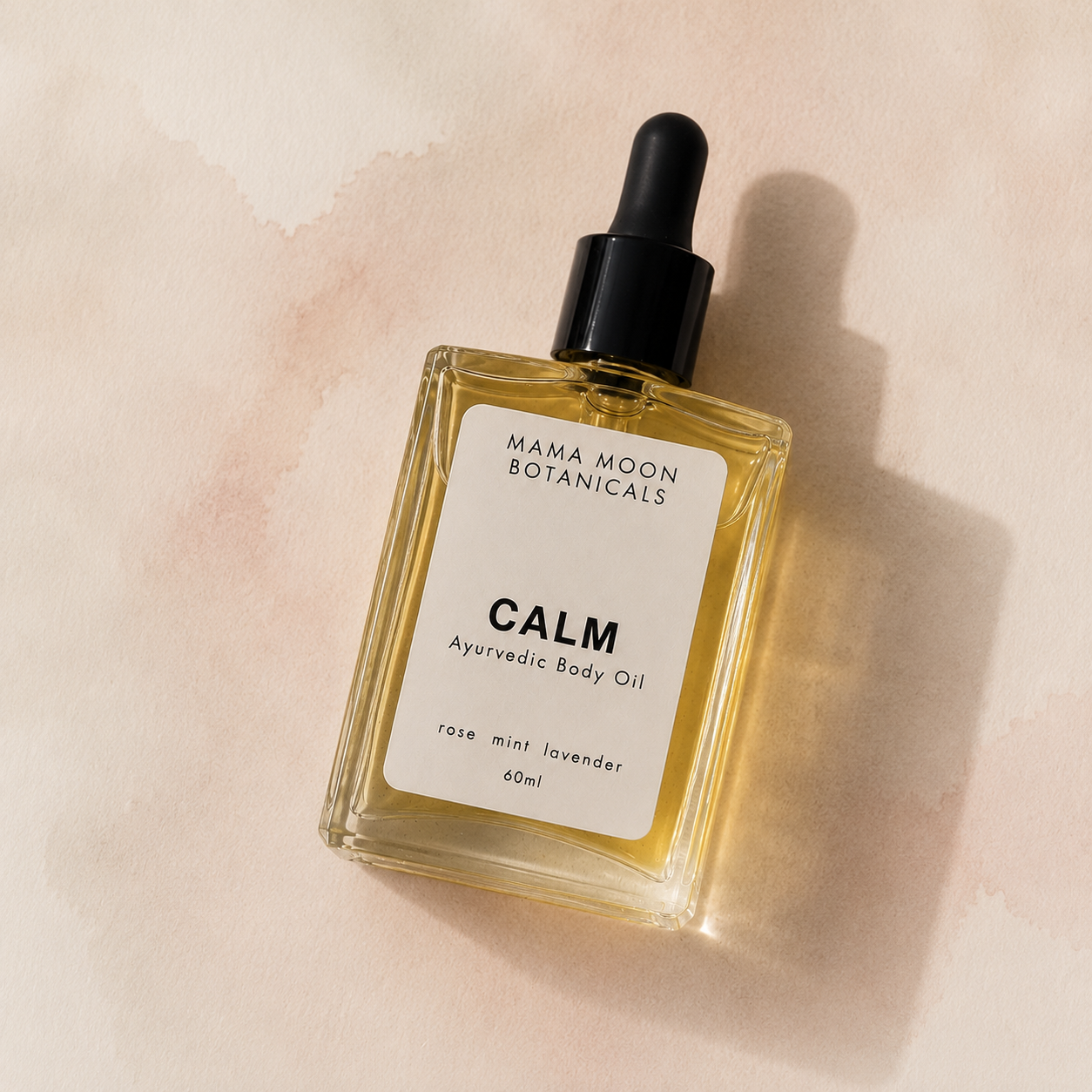
CALM
soothing • calming • cooling
Created with Pitta in mind—for times when there is too much heat or intensity in the mind and body. Cooling and soft, it is the blend I naturally reach for during the warmer summer months.
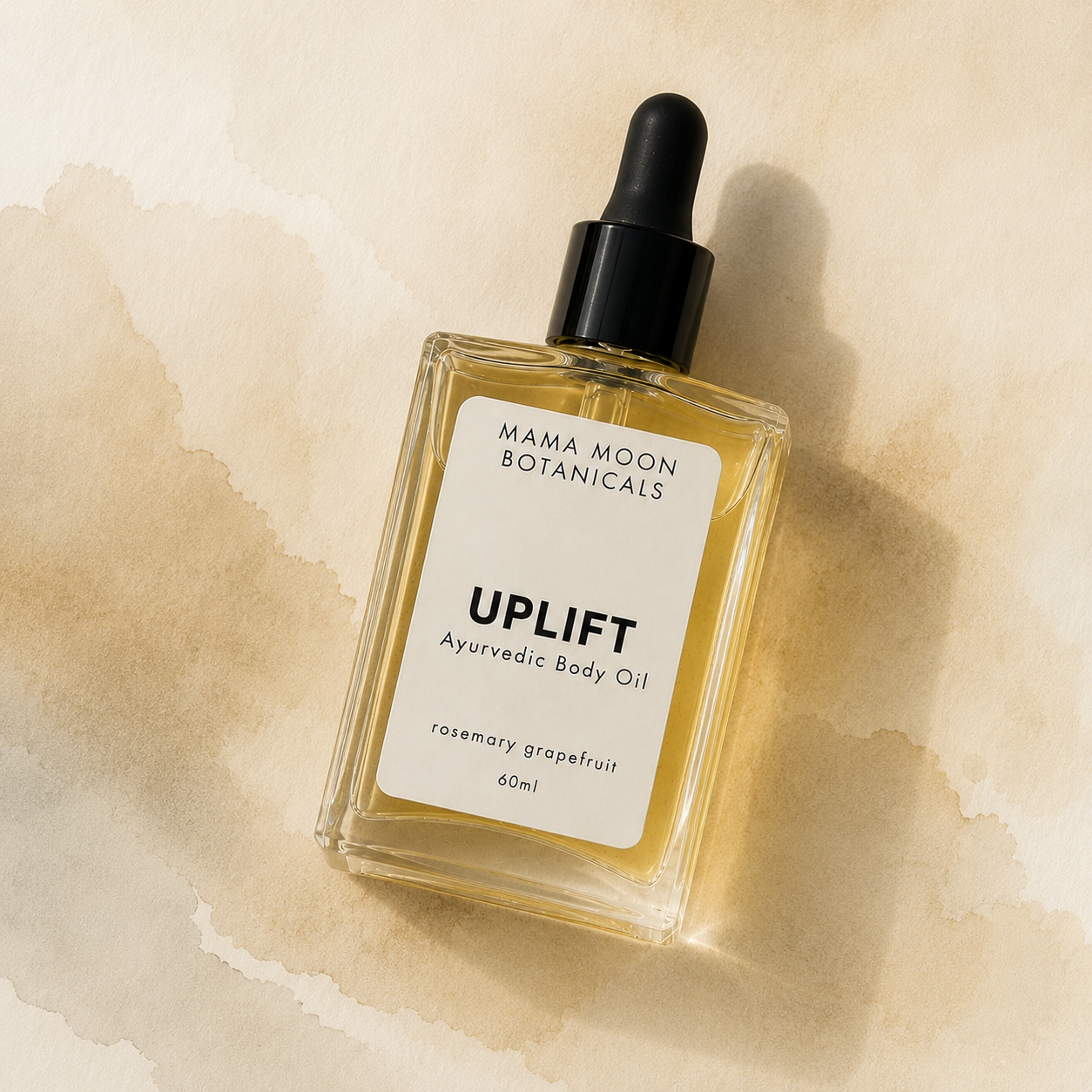
UPLIFT
invigorating • uplifting • fresh
Created with Kapha in mind—for heaviness, stagnation, sluggishness, and those times when the mind and body need more movement. I naturally gravitate toward it during colder, heavier months.
how I practice abhyanga
Traditionally, abhyanga is practiced before bathing.
I gently warm the bottle by placing it in warm water for a few minutes, or I simply pour some oil into my hands, warm it between my palms, and slowly begin massaging it into the body.
I use:
○ long strokes along the arms and legs
○ circular movements around the joints
○ circular massage across the torso
○ extra attention anywhere that feels tight, dry, sore, or tired
Then I allow the oil to absorb for about 5–15 minutes before bathing.
But after years of practicing this, I've also learned that a ritual doesn't have to be rigid to be valuable.
Sometimes I oil before bathing.
Sometimes I apply it after a shower while my skin is still warm and leave it on overnight for extra nourishment—and a really good night's sleep.
And some nights, I simply massage the soles of my feet before bed.
healing for the subtle body
As my studies in Ayurveda, aromatherapy, and botanical formulation deepened, I began understanding more about the plants and oils I had instinctively been reaching toward for years.
That education eventually became part of my formulations.
The Ayurvedic body oils were actually some of the first products I developed for MAMA MOON BOTANICALS, along with the bath salts.
Over the years, I've continued refining the formulas. And while they ended up taking a bit of a back seat as the perfume collection grew, the body oils have always felt deeply connected to the heart of MAMA MOON BOTANICALS.
They came from years of lived practice—warm baths, sore joints, bottles of oil beside the bed, studying plants, learning Ayurveda, and slowly developing a very different relationship with my own body.
In many ways, this is MAMA MOON BOTANICALS.